

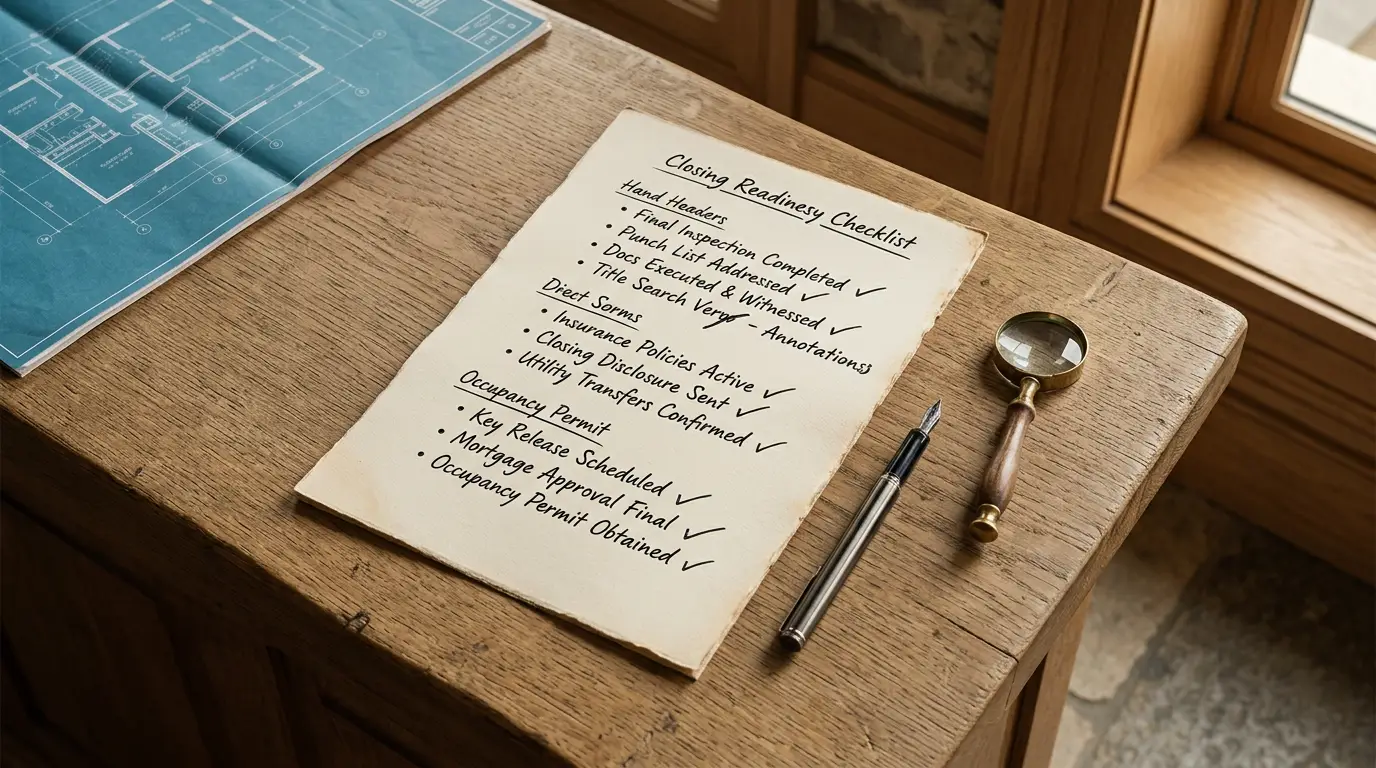
Closing readiness is a maintained operational state: the required evidence is available, unresolved blockers have owners, and the authorized teams can see what must happen next for each buyer and unit. It is not a legal opinion, lending decision, title decision, or guarantee that a closing will occur.
Use this framework to define readiness for a project and to keep the supporting record current. The project team and its professional advisors should determine the actual requirements.
Define readiness states before building a dashboard
Avoid reducing readiness to a single unchecked box. Use states that explain both the evidence and the remaining work.
- Not assessed: the applicable requirements have not been evaluated.
- In progress: required items are being collected or reviewed.
- Blocked: a named issue prevents the file from moving to the next approved state.
- Ready for authorized review: the operating checklist is complete and available to the responsible team.
- Exception: the file requires a nonstandard decision or additional evidence.
- Approved for the next handoff: the authorized role has recorded its decision.
“Ready for review” should not be labeled “approved.” The system can assemble evidence and status; authorized people make consequential decisions.
Buyer and identity checklist
Confirm the project-specific record includes:
- Buyer and co-buyer identities associated with the contract
- Current contact details and approved communication preferences
- Purchasing entity or trust information when relevant
- Approved identity or access checks required by the workflow
- A clear owner for unresolved identity discrepancies
Collection does not equal verification. Record who is authorized to verify an item and where that decision belongs.
Contract and document checklist
The operating record may need:
- Reservation and purchase agreements
- Required signatures and acknowledgments
- Amendments, addenda, and disclosures
- Entity documents when the buyer is not purchasing individually
- Current document versions and links to the authoritative repository
- Review status and owner for each outstanding item
For a fuller document process, use the preconstruction document readiness framework.
Payment and finance checklist
Coordinate with the finance team to define what “financial readiness” means inside the operating workflow. It may include:
- The payment schedule recorded in the authoritative system
- Ledger status for required milestones
- Unmatched or disputed entries routed to an owner
- Required financing or proof-of-funds documents, if applicable
- A record of the finance review or handoff expected by the project
Do not treat a workflow status as a bank confirmation, lending decision, or financial approval unless the authorized source and role explicitly provide that decision.
Communication and open-item checklist
Before a file moves to the next handoff, make open work visible:
- Buyer questions that still require a response
- Requests the buyer must complete
- Internal decisions awaiting an owner
- Partner actions awaiting confirmation
- Approved instructions that should be communicated to the buyer
- The channel and owner for the next communication
The goal is not to claim that every question is resolved. It is to show what remains open and who is responsible.
Maintain a blocker record
Each blocker should explain:
- What is blocked? Name the readiness requirement or handoff.
- Why is it blocked? Record the missing, conflicting, or pending evidence.
- Who owns the next action? Assign a person, team, or authorized partner role.
- What resolves it? Define the evidence or decision needed.
- Where is the source? Link to the authoritative record without copying unnecessary sensitive data.
- What happened before? Retain the relevant status and decision history.
A blocker without a resolution condition can remain ambiguous even when it has an owner.
Human review, exceptions, and handoffs
Route a file to human review when:
- Buyer, unit, or contract records do not match.
- A required document is missing, expired, inconsistent, or disputed.
- Payment records conflict or require finance interpretation.
- A legal, title, tax, financing, or contractual question appears.
- A requested exception is outside the standard project policy.
- A source system is unavailable or the data is not current enough for the decision.
The readiness workflow should identify the issue and carry the supporting context. It should not make a professional or contractual judgment on behalf of the authorized reviewer.
At each handoff, record the sending role, receiving role, evidence included, open exceptions, decision requested, and resulting status.
A practical review cadence
Treat readiness as part of regular buyer operations rather than a one-time pre-closing exercise.
- Review new or changed buyer records when the workflow receives them.
- Reassess readiness when a required document, payment status, contract term, or project milestone changes.
- Keep exceptions visible until an authorized person closes or replaces them.
- Review aging or ownerless blockers through the team's normal operating process.
- Confirm that final handoff states still match the authoritative sources.
This is a process recommendation, not a promised closing result or timeline.
Readiness record template
For each buyer and unit, maintain:
- Current readiness state
- Applicable checklist version
- Evidence links by requirement
- Source system and last observed status
- Open blocker and resolution condition
- Current owner and next action
- Human decisions and timestamps
- Authorized handoff status
The record should make it possible to review the file without treating the context layer as the owner of every underlying document or ledger entry.
Put the checklist into the buyer workflow
Explore Asterisko's closing-readiness workflow, review the buyer-question response policy, or see how to connect CRM, ERP, document, and payment context.
Asterisko is designed to keep approved readiness states, evidence links, blockers, and handoffs connected across the buyer lifecycle. The project team defines the requirements and retains authority over review and approval.